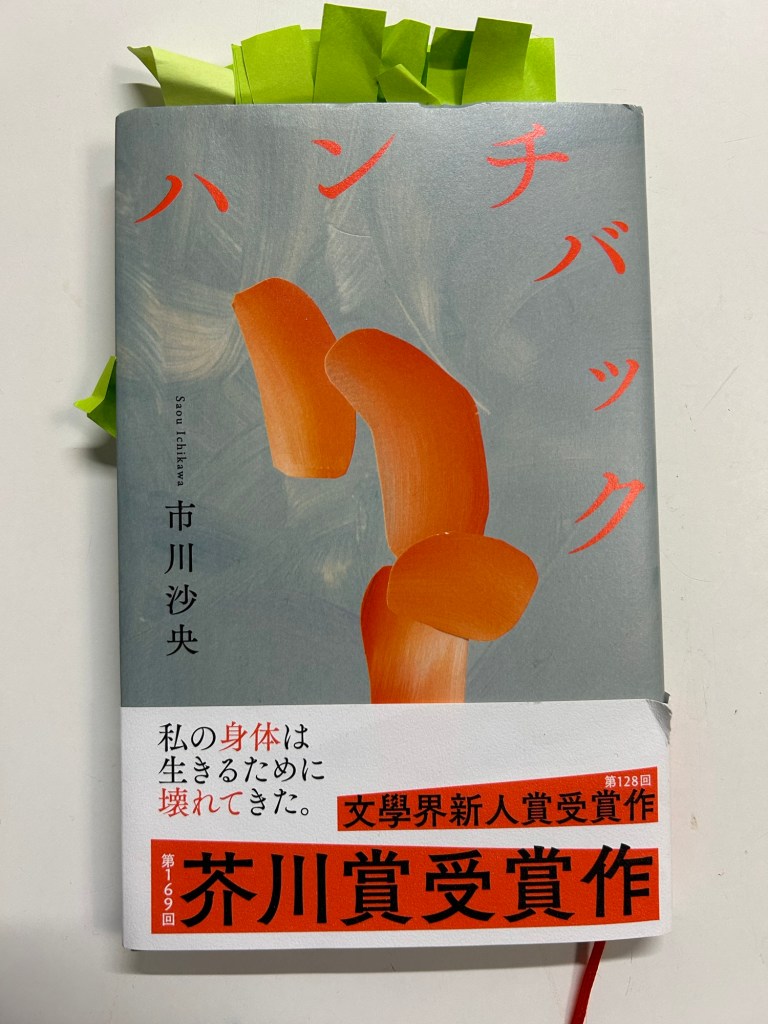
“That time I snuck into one of the biggest happening bars in Tokyo…” That’s how this novel starts. From there, it delivers shock after shock, a fusillade of gut punches, over 93 of the most exhausting pages you might ever read.
The author goes all out in her depiction of the daily life of the protagonist, Shaka Izawa, a woman in her 40s afflicted by myotubular myopathy. The rare disease causes “profound muscle weakness” in affected individuals and can make them dependent on ventilators and wheelchairs.[1] It often leads to skeletal issues including curvature of the spine[2], as in the case of the protagonist, whose severe scoliosis makes breathing difficult and sitting up in a chair a painful and enervating toil. She nevertheless sits at her desk every day during her waking hours, to prevent her muscles from atrophying and rendering her incapable of desk work.
The protagonist lives in a group home, a renovated condominium unit, her care managed by helpers and care managers and paid for by an inheritance left by her parents. The book offers few details about her parents, such as how they came into affluence and how old the protagonist was when they passed away. It’s one of the mysteries that keeps the reader hooked, eager for any hints on what might have happened.
Tanaka, a male caregiver in his mid-30s, helps with the protagonist’s daily care. The two tolerate each other but have little rapport. Helping to smooth things over while keeping the overall mood of the facility relaxed and positive, or at least civil, is Suzaki-san, an experienced female caregiver. Fellow flat mates include a middle-aged man with a spinal cord injury whose relationship with the uncaring and callous Tanaka is just as fraught as the one between the protagonist and Tanaka.
As if that wasn’t enough stress and drama, the protagonist, who earned an online degree from a private Japanese university, makes her living as a writer of pornographic fiction.
This is where the impressiveness of the novel, and the author’s attitude toward life and writing, hit me with full force.
How does a person with physical ailments so severe that the use of a ventilator and an electric wheelchair is a regular part of their everyday life, earn an online university degree, make a living as a writer, and write a novel worthy of the Akutagawa prize? How is she able to bare her experiences and imagination before readers with seemingly so little self-consciousness and reservations, without holding anything back?[3]
Reading this book made me realize and appreciate the depth of resolve it takes to be an author.
[1] PubMed, “X-linked myotubular myopathy.” Retrieved on April 11, 2024. https://pubmed.ncbi.nlm.nih.gov/34736623/
[2] Boston Children’s Hospital, “What is X-linked myotubular myopathy.” Retrieved on April 11, 2024. https://www.childrenshospital.org/conditions/x-linked-myotubular-myopathy
[3] In a dialogue with a fellow writer hosted by literary magazine Bungakukai, the author said she used everything she could to write the novel but cut all unnecessary elements, with the priority on creating an engrossing story rather than writing about her experiences. Source: “What one needs, and what one gives, to become a novelist– interview/dialogue between Junko Takase and Saou Ichikawa.” Published on website “Hon no hanashi” on October 10, 2023, and retrieved on April 11, 2024. https://books.bunshun.jp/articles/-/8285
 Flying Lizard
コメントを残す