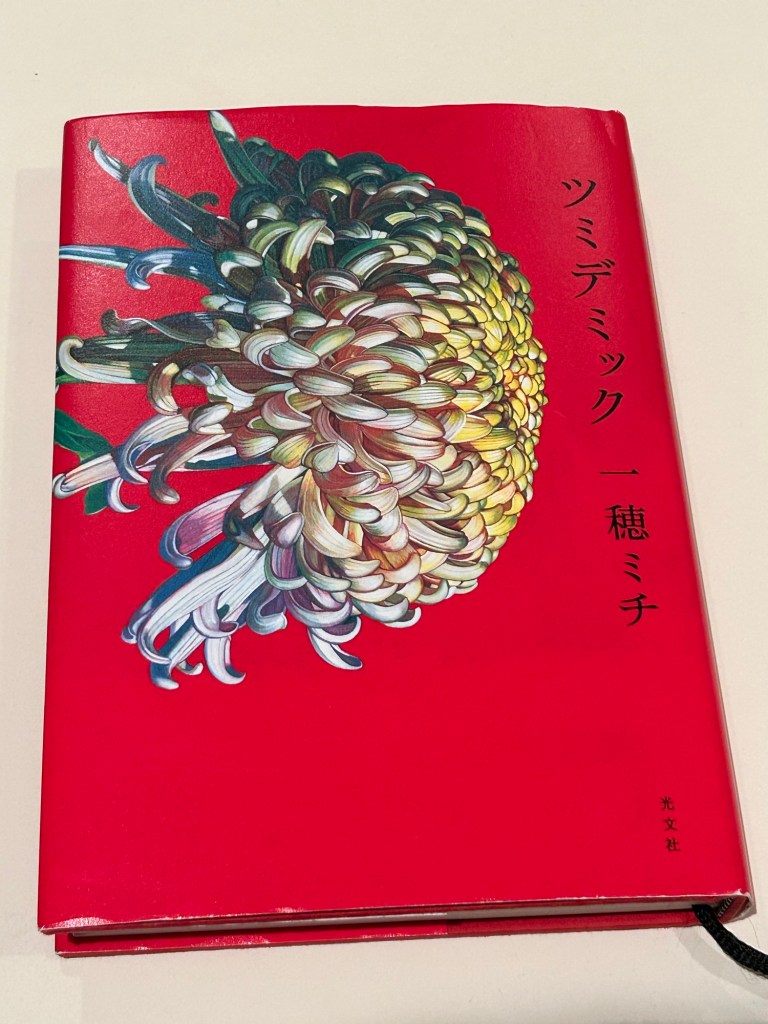
*Updated the final paragraph after the book won the Naoki Prize for 2024 first half.
I was attracted to this book by its eye-catching cover—bright red and adorned with a chrysanthemum flower—as well as its title “Tsumidemic.” The word “tsumi” can mean crime or guilt in Japanese. It also calls to mind the colloquial expression “tsunda,” as in you’ve landed in dire straits, stuck between a rock and a hard place with no means of escape. Combine that with “demic” and the title calls to mind people struggling in the throes of a pandemic. Only question being, a completely fictional one or COVID-19?
The book comprises a collection of six short stories titled “Birds of Different Feathers,” “Romance☆,” “Phosphorescence,” “Special Family Relative,” “Song of Celebration,” “A Drive That Leaves Ripples,” and the common thread running through the stories is the COVID-19 pandemic. The protagonists can’t help but ruminate about how the depths of the pandemic disrupted their livelihoods and left them scrambling to pick up the pieces.
Conversations among characters are life-like and natural. The plight of the male characters, and their struggles to carry out their family responsibilities, are all too familiar and relatable.
The author does an impressive job weaving in references to current events, some of which affect the protagonists and the plot in shocking and surprising ways.
In fact, most of the stories contain surprising plot twists. The story with perhaps one of the more straightforward plots is “Special Family Relative,” a story about a father and son who become acquainted with an old man who lives nearby. One day, the man gives the boy an old Shotoku Taishi[1] 10,000-yen note that was last issued in 1986. That stirs the imagination of the boy’s father, Kyoichi—a former sushi chef who lost his job during the pandemic. Suspecting that the old man has hidden wealth stashed at home and eager to earn some pocket money, Kyoichi tries to ingratiate himself to the old man by making him soup—flavoring it with dried seaweed just as he’d learned in his days as a chef—and offers to run some errands. The old man takes him up on his offer and asks Kyoichi to buy a take-out bento lunch from a nearby restaurant chain. I found the story easy to relate to, and it brought tears to the corners of my eyes as I read it.
The first story, “Birds of Different Feathers,” features Yuto, a bar tout in his 20s who dropped out of college. One evening, he is approached by a blond-haired woman in her 20s wearing a bright red trench coat and high heels. They agree to meet at a bar after his shift. She then drops a bombshell, claiming to be Nagisa Inoue, a former classmate of Yuto’s from junior high school. The catch—Yuto is certain she passed away years ago, during their school days.
The second story, “Romance☆,” is about a woman who becomes addicted to ordering takeout food from a home-delivery service, in the hopes of meeting a deliveryman that she glimpsed on the street and is attracted to.
The third story, “Phosphorescence” is a story of revenge. The story is narrated by the ghost-like spirit of a high school-aged girl, who regains consciousness outside her school, resting near a tree, which according to urban legend has the power to grant people’s wishes. The spirit soon recalls that she had passed away several years ago on a day of torrential flood rains. She was presumed to have slipped down a riverbank and drowned—a tragic accident. Now, her remains have finally been found. That leads to a reunion of her best friend from high school, who shows up in a sharp-looking business suit, and their former homeroom teacher, now a successful businessman at an educational services company. The two visit the deceased girl’s mother to honor her memory.
The fifth story, “A Song of Celebration,” is about a high school girl who has become pregnant, triggering her father’s angst. Another prominent character is her grandmother’s next-door neighbor. The neighbor had looked happy earlier when she and her husband moved in but has recently started avoiding contact with her neighbors.
The sixth story, “A Drive That Leaves Ripples” is about a group of people who meet each other in person for the first time, having gotten acquainted on social media. They are driving out to a remote area to carry out their plan. The gathering, though, turns contentious as they start telling each other their life stories and their motives for joining the trip.
All these stories are dark and often distressing. They call to mind stories by Stephen King, full of authentic-sounding conversations, foreboding and frightening moments in superficially mundane situations. I came away impressed with the unexpected plot twists and the way the author deftly weaved in references to current events. Of all the books I’ve read so far in 2024, this is the one that has left the strongest impression.
Perhaps the biggest surprise is the author’s background as a prolific writer of so-called Boy’s Love novels. The author, Michi Ichiho, however, might soon become better known as a writer of general fiction. “Tsumidemic” won the 2024 first half Naoki Prize, one of the most prestigious accolades for works of Japanese fiction. The prize, for the best entertainment literature book by an emerging or medium-tier author, is awarded semi-annually by the Society for the Promotion of Japanese Literature.
[1] Shotoku Taishi became regent and crown prince in the late 6th century during the reign of Emperor Suiko, and enacted Japan’s first written constitution, the Seventeen-Article Constitution in 604. https://eifukuji-taishi.jp/taishi.php,
 Flying Lizard
コメントを残す