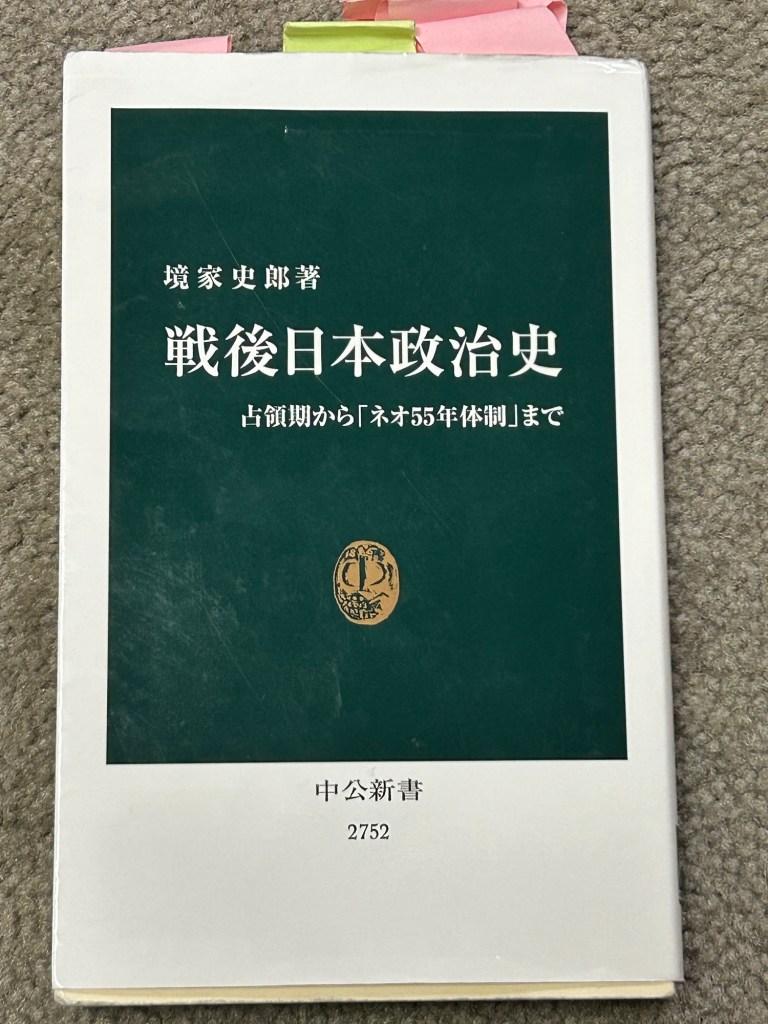
This book, Postwar Japanese Political History, covers the period from the end of World War II on Aug. 14, 1945, when Japan accepted the Potsdam Declaration and surrendered to the Allied Powers, to September 16, 2020, when Prime Minister Shinzo Abe’s cabinet resigned en masse, ending his second term[1] as prime minister, which was the longest consecutive term in Japan’s constitutional history.[2]
The author, Shiro Sakaiya, a political science professor at the University of Tokyo’s graduate school, details the evolution of Japanese politics during that 75-year postwar era. He highlights how ideological differences over the postwar pacifist Constitution and national defense policy, which emerged as a political issue in the early 1950s, remain unresolved. Differences over whether to maintain or revise Article Nine, which renounces war as a sovereign right of the nation and the threat or use of force as a means of settling international disputes, while adding that land, air and sea forces will never be maintained,[3] has splintered the opposition parties, Sakaiya says, adding that their inability to coalesce into a single, coherent political group has helped strengthen the ruling Liberal Democratic Party’s (LDP) grip on power.
The author’s observations have been borne out by the outcomes of recent general elections. Even in cases where opposition parties managed to agree on electoral cooperation and ran single, unified opposition candidates in single seat districts, such efforts haven’t always gained popular support, as many voters remain wary of any cooperation among opposition parties that involve the Japanese Communist Party.
Sakaiya also explains how the so-called “1955 system” characterized by a confrontation between the LDP – the ruling party for the bulk of the postwar era—and the main opposition Socialist Party, has since morphed into a “Neo 1955 system” pitting the LDP against the main opposition Constitutional Democratic Party. Under this new political regime, the prime minister and cabinet wield greater policy-making powers than before, thanks to a series of reforms that strengthened the capabilities of the Cabinet Office and Cabinet Secretariat, and electoral reforms that led to the establishment of one-seat, winner-take-all electoral districts. Coupled with a public that has grown increasingly skeptical of opposition parties’ ability to govern, the LDP’s status as a dominant ruling party has become firmly entrenched, according to the author.
In this vein, Sakaiya notes that an important development during the 2021 lower house election, which saw the LDP gain 261 seats, well over the 233 needed for a majority, was that the centrist Democratic Party for the People started to distance itself from the opposition camp and began cooperating with the ruling parties, a development that mirrors the Democratic Socialist Party’s actions in the old 1955 system. This trend is evident again in the present day, in 2024. After the latest general election held on Oct. 27, the LDP has sought to cooperate with the Democratic Party for the People on specific policies such as revising the so-called 1.03-million-yen income tax threshold, according to media reports, so as to secure their support for a forthcoming supplementary budget being drafted by the government.
In the book, the author divides the 1945 to 2020 post-World War Two era into four phases. Phase one lasted from 1945 to 1960 when the foundations of Japan’s postwar constitutional system took shape, including the formation of the LDP in November 1955. Phase two encompasses the 1960s to the early part of the 1970s, which the author refers to as the first half of the “1955 system.”
The main characteristics of the first half of the 1955 system include the splitting up of the main opposition Socialist Party into multiple opposition parties, ideological confrontations between conservatives and liberals becoming more formulaic, and the growing influence of vested interests.
The author reckons that phase three, the second half of the 1955 system and a period encompassing the latter half of the 1970s to the 1980s, was the most socially stable period in Japan since the 1868 to 1912 Meiji era.[4] The ruling LDP solidified its grip on power during this period of stable economic growth, with the biggest political battles occurring within the LDP itself, as party factions competed fiercely to gain control of the party and the premiership. The internecine squabbling within the LDP, the lack of a change in power, coupled with public anger and disillusionment toward increasing political corruption, formed the backdrop for a rise in political apathy. Such developments gave birth, the author notes, to a refrain often heard in Japan in the 1980s: first-rate economy, third-rate politics.
Phase four, which the author calls “the age of reforms,” lasted from the 1990s to 2010.[5] The calls for reforms grew louder amid voter anger over political corruption, which came to the fore after the Recruit scandal of the late1980s. During this period, political fault lines shifted from ideological differences over national defense policy and the country’s pacifist Constitution, to a confrontation between reformers on the one hand and defenders of the status quo on the other.
It was also a period characterized by external pressure from the United States against Japan to implement economic reforms. That came to a head in the 1990s as tensions simmered over Japan’s hefty bilateral trade surplus, with the U.S. side calling for changes such as the removal of non-tariff barriers that were said to be hampering the exports of U.S. goods to Japan.
The period also marked the end of the “1955 system” and the LDP’s stranglehold on power. In June 1993, members of the LDP split from the party and voted with the opposition in supporting a no-confidence motion brought against then-prime minister Kiichi Miyazawa, prompting Miyazawa to dissolve parliament and call a snap election. After the LDP failed to win a majority in the poll, a multi-party non-LDP coalition was established, leading to the formation of a cabinet led by the leader of the Japan New Party, Morihiro Hosokawa in August 1993. Hosokawa, however, abruptly resigned in April 1994 amid a controversy over a 100-million-yen loan he had received in the 1980s from parcel delivery firm Sagawa Kyubin. Tsutomu Hata, leader of the Shinseito, succeeded Hosokawa as prime minister in April 1994 but stepped down just two months later, when his cabinet resigned en masse after opposition parties brought a no-confidence motion for parliamentary vote.
That opened the way for the LDP to return to power in June 1994, when they forged a coalition with their longtime nemesis, the Socialist Party, and anointed Socialist Party head Tomiichi Murayama as prime minister. Murayama resigned in January 1996 and handed over the reins to the LDP’s Ryutaro Hashimoto, who was succeeded by Keizo Obuchi and Yoshiro Mori.
In 2001, Junichiro Koizumi came to power after his surprising victory in the LDP party leadership race against Hashimoto, who sought a second term. The period of reforms drew to a close with the end of Koizumi’s term in office.
Phase five, from the mid-2000s to 2020, was marked by the re-emergence of ideological divides in Japanese politics, according to the author. The period started with the formation of Shinzo Abe’s first cabinet and lasted until the end of his second term in power. Confrontation over the pacifist constitution and national defense policy came to the fore again during this period, leading to the formation of what the author calls the “Neo 1955 system.”
Like the old 1955 system, the new regime features a conservative party as the dominant ruling party, with the ruling party and main opposition party divided along ideological lines.
Differences with the original 1955 system, on the other hand, were born in the wake of the political reforms of the 1990s, which had two principle aims, according to Sakaiya. One aim was to create an electoral system that increases the chances of changes in power, and to bolster the prime minister’s leadership and ability to respond to domestic and international crises.
While reforms to increase the prime minister’s power proceeded and had the desired effect, political developments since 2012 show that the electoral reforms did little to make changes in power more frequent, Sakaiya notes.
One reason for this is the fact that the overall structure of the 1955 system, in which the ruling and opposition parties are split according to their stances toward the country’s pacifist Constitution and national defense policy, remain intact. Such ideological differences have prevented the opposition parties from uniting into a larger political unit, making it easier for the LDP to stay in power.
The latest political developments, in the wake of the general election on Oct. 27, 2024, in which the ruling coalition comprised of the LDP and the Komeito fell well short of securing a majority in the lower house of parliament, validates Sakaiya’s point. Even though the opposition parties combined won enough seats to form a majority, the three largest opposition parties, namely the main opposition Constitutional Democratic Party, the Democratic Party of the People, and the Japan Innovation Party, showed little interest in coordinating and agreeing on a unified prime ministerial candidate to stand against the LDP’s Shigeru Ishiba. As a result, Ishiba managed to be re-elected as prime minister after a runoff vote in the lower house even though the LDP and Komeito ruling coalition lacked a majority.
Sakaiya touched upon the challenges facing the opposition parties during a December 2023 dialogue session with political scientist Jiro Yamaguchi at the Asahi Culture Center.
In the past, any mention of revising the constitution would bring down the popularity of the ruling LDP, but in recent years, voter reaction to the topic has changed. The average voter isn’t put off when a political party calls for revising the Constitution, Sakaiya said, adding that voters aren’t very interested in the topic. In the past, starting from the cabinet of Hayato Ikeda, who pledged to double the size of real gross national product in 10 years[6], putting the economy at the forefront of his policy priorities as prime minister, whenever the ruling parties raised the topic of revising the Constitution, the cabinet’s support rating would fall, Sakaiya said. But nowadays, that topic is a positive one for the LDP, because it exposes the divisions within the opposition camp and splits them apart, he added.
It has become difficult for voters to find a clear rationale to support the opposition, non-LDP camp, and that is why dislodging the LDP from power is difficult, and why, even if that were to happen, any such period is likely to prove short-lived, Sakaiya said.
Voters are being forced to choose from among opposition parties who are split according to their stances on revising the Constitution, a topic that the average voter doesn’t seem to care that much about, he added.
In this way, Sakaiya says in his book, the existence of Article Nine of the Constitution has, paradoxically, benefited the LDP, which has been calling for revising the Constitution ever since the party was established on Nov. 15, 1955.
As long as differences over whether to revise the Constitution remain unresolved, and the issue continues to be framed as a choice between “militarism and democracy”, this country’s postwar period will never end, Sakaiya says in conclusion to his book.
[1] Abe’s first term as prime minister lasted just over a year, starting in September 2006 and ending in September 2007. His second term comprising his 2nd to 4th cabinets lasted nearly eight years, from December 2012 to September 2020.
[2] Abe was the longest-serving prime minister in Japan’s constitutional history going back to the late 19th century, and specifically, since the Meiji Constitution of the Empire of Japan was promulgated on Feb. 11, 1889. Both his second term, which last 2,822 days and his cumulative term totaling 3,188 days, were the longest in the country’s constitutional history. (Source: “Abe Cabinet Resigns En-masse, Longest Consecutive Term Ends At 2,822 Days,” Nihon Keizai Shimbun online edition, Sept. 16, 2020.)
[3] Website of Prime Minister’s Office of Japan, The Constitution of Japan, promulgated on Nov. 3, 1946, came into effect on May 3, 1947.
[4] Postwar Japanese Political History: From the Occupation Period to the “Neo 1955 System,” Shiro Sakaiya, Chuokoron-Shinsha, 2023, p.103.
[5] Postwar Japanese Political History, p.153.
[6] National Archives of Japan, “10. Plan for Doubling the National Income,” To the High-Growth Period: 1951-1972, 2015.
 Flying Lizard
コメントを残す