
I’d never read any of Banana Yoshimoto’s books until this year. I remember her immense popularity in the 1990s, but back then my primary reading interests were non-fiction books, and I had little interest in literature and novels.
Earlier this year, I came across a Q&A that Yoshimoto had done with the New York Times,[1] in which the author was asked about the last great book that she’d read. In her reply, Yoshimoto brought up “Elemental: Critical Essays,” by Keijiro Suga. The book “reads like a beautiful novel,” she said. “I feel blessed to be alive at the same time as someone as amazing as he is.”
Prodded by the unadulterated praise, I bought Suga’s book shortly thereafter. But Yoshimoto’s words also made me curious about her own work. This was especially the case after I’d been shocked and surprised recently after reading a few Japanese books that won literature prizes in the past couple of years, including Sao Ichikawa’s “Hunchback”, Kanto Stephaine Ota’s Midoriiseki, and “Tsumidemic” by Michi Ichiho.
All these books were vivid, visceral, and shocking.
That left me wondering, what kinds of surprises does Banana Yoshimoto have in store for readers of her books?
That’s how I came across “Psychic in the Old Town” one day, at the main Maruzen store in Tokyo. The cover seemed innocuous enough, looking to me like something that might adorn a collection of essays. I figured I was picking up a relaxing book that could be read casually, one with an upbeat tenor and message.
Was that impression ever wrong.
The protagonist is a teenaged girl named Kiyoka, a junior high school student who lives in an old town area of Tokyo with her mother. One day, she asks a friendly neighbor, whom she calls “Uncle Tomo,” why adults often become overcome by greed and lust. The girl’s parents had recently divorced, and she recalls having hated living in a home where her mother and father were always either arguing or embroiled in a pre-argument standoff.
Both Kiyoka and Uncle Tomo have psychic-type abilities, able to sense negative vibes and spirits of all kinds, whether they are malicious or just plain sad. Kiyoka’s ability to sense when a space is unclean and contaminated by negative energy is stronger than Uncle Tomo’s, which is why he has tasked her with the job of keeping clean a “study room” that he runs, a place where children and passersby can drop by to study or read, giving her 900 yen for every 30 minutes of work.
The emotions conjured up by the book, its overall mood and dark tone of its stories, reminded me a lot of what I experienced reading “Tsumidemic,” a book by Michi Ichiho that I read earlier this year. The sense of foreboding I felt as I read “Psychic in the Old Town,” the sense that something bad is lurking just up ahead, maybe in the next 10 pages, reminded me of how I felt when I read Cormac McCarthy’s “No Country for Old Men,” although “Psychic in the Old Town” isn’t nearly as violent on the surface.
Taken together with recent novels like Ota Stephanie Kanto’s “Midoriiseki,” a story about a group of high school students in Tokyo who sell and consume cannabidiol (CBD), an ingredient contained in marijuana, and end up being stabbed and beaten up by a rival group, it’s enough to make me wonder if there is a dark pall hanging over Japanese society right now, and that these books are somehow the byproduct of that. Are these authors sensing this pall and channeling it, producing such works of fiction as some kind of warning?
In “Psychic in the Old Town,” Kiyoka’s father, Toshiya, starts dating a strikingly beautiful woman, a 22-year-old who works at a neighborhood bakery, about a year after he divorced Kiyoka’s mother. She had eloped with a man from the northern Japanese island of Hokkaido but has since split up and is now living with Toshiya. Wanting to know more about the woman, Kiyoka decides to observe her from outside the bakery. She becomes nauseous as she notices a dark cloud hovering behind the woman, pulsating with the resentment of all the men that she left in her wake.
Dating the woman takes a toll on Toshiya. Kiyoka is shocked when she runs into her father one day, looking tired, disheveled and forlorn. He tells Kiyoka that the woman he has been seeing is dealing with emotional issues and taking medication. Belying the sympathy she feels toward her father, Kiyoka is surprisingly dismissive, telling him not to tell her things she doesn’t need to hear.
A while later, toward the end of spring, Toshiya ends up in the hospital after surviving a suicide attempt. The woman has disappeared. She is not working at the bakery anymore and hasn’t visited Toshiya in the hospital. Kiyoka and her mother visit Toshiya. Kiyoka senses that the visit has infused her father with energy, and he tells them not to worry; he’s over it now.
As Kiyoka leaves the hospital with her mother, she senses that the woman is nearby and decides to confront her alone. For the first time in her life, Kiyoka thinks she might be killed by a person standing in front of her. This person harbors absolutely no love for me, she thinks to herself.
The woman tells Kiyoka that she had been an aspiring “idol” in Sapporo, the largest city in Hokkaido. The woman had been a performer and a member of an idol group, until, one day, she fell off the stage and broke her leg and had to take prolonged leave. By the time she was ready to return, she could no longer dance like before and her place in the idol group had been taken by someone else.
After that, nothing seemed to matter anymore, the woman told Kiyoka. She plans to return to Sapporo soon, but doubts there will be anything better to look forward to in life.
Kiyoka asks the woman what she liked about her father. The woman says she particularly liked his reply to one of her requests. Toshiya had refused, saying: That’s all wrong. That’s like using a hair dryer to warm yourself. I don’t use things in ways they aren’t meant to be used, he went on to say.
Shaken by the encounter, Kiyoka returns to Toshiya’s hospital room, where she regains her composure while watching her father sleep.
This first episode of the book is titled “Dryer.” I read it as a parable for all the things that can go wrong when a person loses sight of what they want and tries to hide it from themselves with self-deception.
The book is comprised of five episodes in all. The title of the second story is “Seidaku,” a word that means clean and dirty, or good and evil, and is typically used in a phrase that describes a willingness to accept and get along with all kinds of people. The main character of the story is “Shin-san,” a man in his early 70s who always dons a grey-colored suit made of expensive-looking fabric, wears shiny black shoes, and has, for the past 20 years or so, taken it upon himself to direct traffic on a road in front of the “study room” that Kiyoka is responsible for cleaning. People are never quite sure what to make of him, but Kiyoka and other children in the neighborhood respect Shin-san as someone who has blended into the local scenery and belongs there.
The third story is “Botandoro,” an apparent reference to an old horror story, one that was performed as a play at the Kabukiza theater[2] in Tokyo in 1892[3]. In the old tale, a woman becomes ill after falling in love with a man and then returns to meet him as a ghost and ends up killing him.
The story in “Psychic in the Old Town” revolves around the ghost of a girl who can’t recall her exact name. Kiyoka calls her “Tomo-san.” The girl, named Tomomi, passed away due to an illness. She asks Kiyoka to tell her boyfriend and her parents that all she wants is for them to be happy.
Meeting Tomomi leaves Kiyoka with an appreciation of how people’s time on earth is limited and finite. She experiences how relationships can leave an indelible impression, no matter how fleeting they may turn out to be.
The fourth story is “Konkatsu,” which means something along the lines of “marriage-seeking activities.” Uncle Tomo announces that he is marrying his girlfriend Sakura-san when she returns from Rome. Sakura-san, who is much younger than Tomo, has been working at a restaurant there, getting training in the culinary arts. Kiyoka also finds a partner. One day, on her way home from school, Kiyoka meets a dog named “Kuro,” and the dog’s master “Kunito Wada.” When Kiyoka’s hand briefly brushes Kunito’s, her hand tells her that it doesn’t want to be separated from his hand. Kiyoka eventually marries Kunito, whose parents both died young. He also had a younger brother who passed away. There is a scene where Kiyoka praises Kunito for displaying his family’s pictures in his kitchen, saying that it’s only natural to put your most important things in the best place in the house.
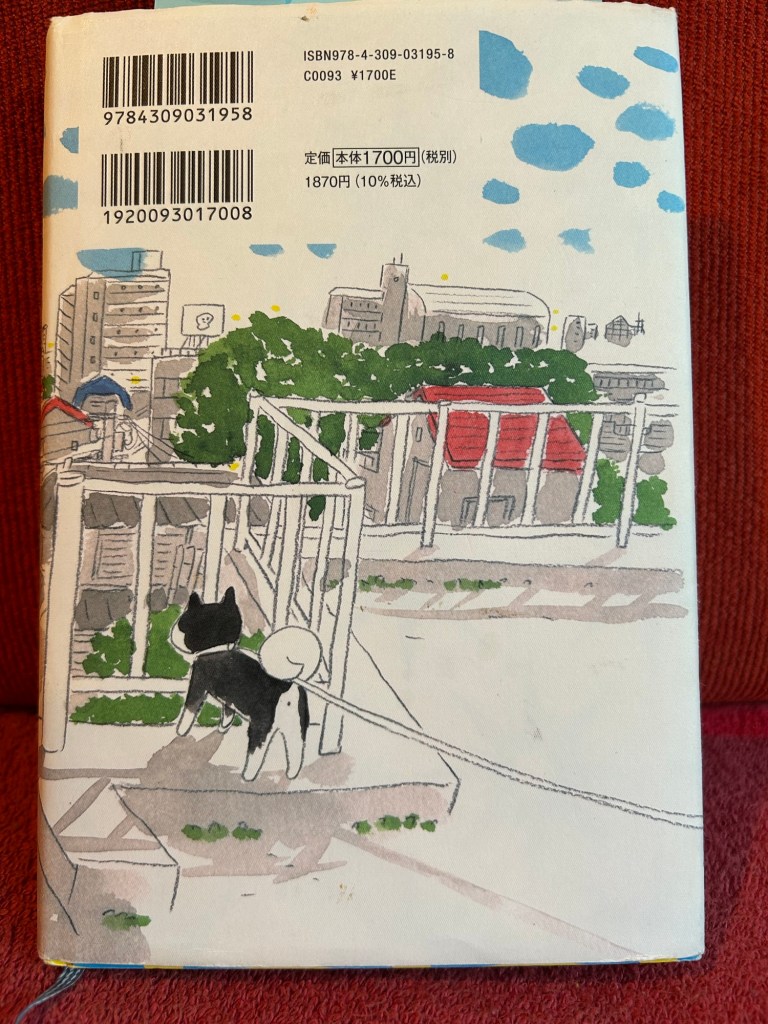
The fifth story, which is also the epilogue, is titled “Ninkatsu.” It deals with the birth of Kiyoka’s daughter, Mio. Kiyoka’s mother still lives in the house that she shared with Kiyoka, who visits her mother almost daily, while Toshiya drops by on the occasional weekend to see his granddaughter. Even after the birth of her daughter, Kiyoka still has her psychic abilities. She comes to the realization that while people can be harmed by dark spirits, in the end, life is what each person makes of it, and the passage of time will solve most problems[4]. As a result, Kiyoka no longer worries or frets about dark spirits.
I was surprised by the psychic and spiritual themes of “Psychic in the Old Town” and the tragic events experienced by its characters, but the author has been writing novels with such themes from the outset, including her perhaps most famous work, “Kitchen,” published in 1987. Her 2018 book, 『「ちがうこと」をしないこと』(Roughly translated, the title means something like “Don’t do things that don’t feel right.”) touches upon the author’s experiences in the late 1980s when every book she wrote sold like crazy and made lots of money. (She says she saw “hell” back then.[5]) and her childhood experience living in an old town area of Tokyo. The author says there was always someone visiting her house because her father, Takaaki Yoshimoto, a poet and thinker, kept the house open to anyone. She was scared of the visitors, some of whom were violent or raucous. Back then, living in an old town area of Tokyo in close proximity with various types of people, she feared for her life[6], she says.
Reading all this made it easier for me to understand how a novel like “Psychic in an Old Town” might come to be. It makes sense to me that a person who constantly runs into frightening strangers would develop extrasensory skills as a defense mechanism. I find it easy to believe the author when she says she has psychic-type abilities.
In the afterword, Yoshimoto says the book contains knowhow on how to live and survive. At the core are the “Old Town rules[7],” inclusive values that allowed community boundaries to be amorphous. The book also deals with meetings of destiny, Yoshimoto says, adding that while such meetings won’t solve problems by themselves, they will, if ever so slightly, open up the path ahead. The author’s hope is that the book will help people recognize how their intuition can be utilized in new ways, knowhow that she refers to as “a slim hope that leads to a way forward[8].” The book might not resonate with readers now, Yoshimoto says, but she implores them to hang on to it, because the lessons contained within might make more sense to them 10 years from now.
Is she somehow worried specifically about the next 10 years starting from 2024, or does she mean 10 years from whenever you first read the book? I tend to think that she may be more worried about the near future. In any event, I’m planning to take up the offer and see how I feel about the book in 2034, looking forward to gaining fresh insights and acquiring knowhow anew that will light the way forward.
[1] “Banana Yoshimoto Wants Books to Give Her Insomnia,” By the Book, New York Times, Oct. 5, 2023.
[2] SHOCHIKU Co., Ltd.’s official Kabuki website has details on the Kabukiza theater: https://www.kabukiweb.net/
[3] The following is a brief summary of the plot of the first half of Botandoro, based on a description on SHOCHIKU Co., Ltd.’s Cinema Kabuki website: https://www.shochiku.co.jp/cinemakabuki/lineup/1796/
Iijima Heizaemon, a Hatamoto, one of the shogun’s elite guardsmen, remarries with Okuni after his wife passed away. His daughter Otsuyu doesn’t get along with Okuni and lives with her caretaker mother Okome. Otsuyu can’t stop thinking about Hagiwara Shinzaburo, the family doctor’s assistant, and she falls ill. When Otsuyu passes away, Okome commits suicide. Hearing this, Shinzaburo decides to pay respects to the dead during the o-bon season. There, he sees Otsuyu and Okome carrying botandoros, or peony-adorned lanterns. Shinzaburo later realizes that Otsuyu is a ghost and puts talismans up in his room to ward her off. Otsuyu pays Tomozo, Shinzaburo’s assistant, to remove the talismans and Tomozo complies. Once re-united with Shinzaburo, Otsuyu kills him.
[4] At least that’s how I interpreted her monologue on pages 249-250.
[5] Chigaukoto wo shinaikoto, Banana Yoshimoto, Kadokawa Corporation, Tokyo, 2021 (2018), p. 98.
[6] Chigaukoto wo shinaikoto, pp. 86-87.
[7] Psychic in the Old Town, pp. 256-257.
[8] 「先に続くわずかな希望」Psychic In The Old Town, p. 259.
 Flying Lizard
コメントを残す