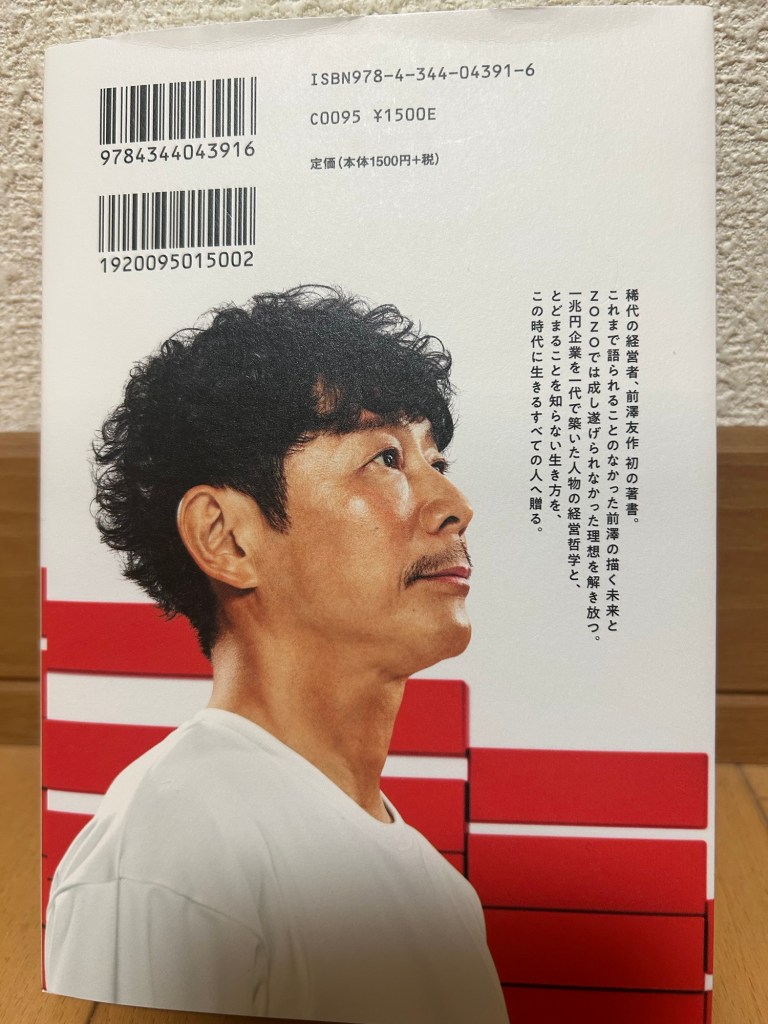
『国民総株主』前澤友作 幻冬舎 東京 2024年 198ページ。

I’ve been intrigued by Yusaku Maezawa ever since he went to space as a cosmonaut. I find it amazing that someone would decide, in their 30s or 40s, that they want to become an astronaut or cosmonaut, go through the rigorous studying and training required, and blast off into space.
Not to mention his success as an entrepreneur. In short, he is the type of person that makes you wonder, how does he get so much done? We all have the same 24 hours in a day, how is he leveraging those hours?
In his book, “Kokumin so kabunushi,” which roughly translated means something like “Shareholder Nation,” i.e. everyone in the country is a shareholder, Maezawa calls on everyone to become an engaged participant of capitalism by becoming a capitalist. His stated goal is to make every Japanese national a shareholder, adding that only 30 percent of Japanese now own shares[1].
Don’t buy stock indices, by shares in individual companies, he says. If you shop at the Aeon supermarket on a daily basis, go buy their shares, he says. By buying from them you’re contributing to their business and bottom line, but only Aeon benefits from the profits they make from you. If you own their shares, you too can share in their success and reap the benefits of their profits through dividend payments, he notes.
The idea of calling for all Japanese to own shares isn’t knew, Maezawa says. Konosuke Matsushita[2], the founder of Panasonic Group and probably the most-renowned Japanese entrepreneur of the 20th century, espoused similar ideas in the 1960s, Maezawa says.
To people who buy his book in Japan, as well as paying customers of his new company KABU & PEACE Inc., Maezawa is offering to hand out pre-listed shares[3] in the firm. The more a customer uses the infrastructure services offered by the company such as electricity and gas, mobile and internet connection services, the more shares they will be entitled to receive[4], according to Maezawa.
As the number of customers grow, the company will grow, and the number of shareholders will increase, he says, adding that his aim is to turn his company into the Japanese company with the largest number of shareholders – a mantle currently held by Nippon Telegraph and Telephone Corporation (NTT), which had 2.44 million shareholders[5] as of end-September 2024.
If more Japanese become shareholders, and the percentage of Japanese who own equities were to increase from around 30 percent and nears levels seen in countries such as the United States of around 60 percent, the price earnings ratio (PER) of the Nikkei share average, a benchmark Japanese stock index, might rise and potentially give the Nikkei a boost, according to Maezawa.
If the number of equities investors grows, listed companies will find it easier to raise funds for investment in capital, human resources, research and development, he says, adding that such investment will lead to productivity gains as well as sales and profit growth, which will contribute to gross domestic product (GDP) and spur rises in salaries and income[6].
“The more people invest in equities and invigorate the market, the more that will be reflected in people’s incomes and salaries. Investing in equities means you become a participant in invigorating the Japanese economy and that is also part of activities to increase your dividend income and salary. So that’s why there should be more and more investors,” Maezawa says[7].
Ultimately Maezawa seems to regard his plan to make everyone in Japan a shareholder a way to reduce inequality while boosting the economy, although he interestingly questions whether the pursuit of an ever-higher gross domestic product is needed. As long as per-capita GDP increases, do we need to be bothered so much by the absolute level of GDP and where it ranks globally, he asks.
Maezawa approaches the issues that were outlined in the 2022 book by David Gelles “The Man Who Destroyed Capitalism,” but offers a different possible solution.
These two books are similar in that they both consider some aspects of the current capitalist society to be problematic. They both highlight the economic challenges faced by people who aren’t capitalists, who aren’t business owners, and who aren’t shareholders.
The book by Gelles examined how share prices can rise when companies spend money on share buy-backs and dividends, which incentivizes them to put money into such activities, possibly diverting money that could have been spent on long-term business investment, as well as salaries for employees and their well-being. “The Man Who Destroyed Capitalism” calls for rollbacks to this trend, urging companies to focus more on long-term investment and allocating money for their employees.
Maezawa’s message, instead, is directed toward individuals. Become a shareholder in a company and become a more engaged participant in the capitalist economic system, he says.
Maybe it’s time I chose a company whose services or products I often use or buy and bought some of their shares.
[1] “Kokumin so kabunushi,” p. 21. He cites the results of a survey conducted by his company. A separate set of data compiled by the Bank of Japan and released in August 2024, Japanese households overall have preferred to park money in bank deposits or hold on to them as cash, compared to holding shares. According to that BOJ study, which compares the flow of funds in Japan, the United States and the euro zone, equities accounted for 14.2 percent of the 2,199 trillion yen in financial assets held by Japanese households, compared to 50.9 percent held in cash and bank deposits. Households in the United States held 40.5 percent of their financial assets in equities and 11.7 percent in cash and bank deposits, while households in the euro zone held 21.5 percent and 34.1 percent, respectively, the BOJ study shows.
[2] In Japan, Matsushita is often referred to as “the God of management.”
Konosuke Matsushita’s official website: https://konosuke-matsushita.com/en/
[3] Maezawa says his aim is to turn KABU & PEACE Inc., which was established in February 2024, into a listed company as soon as possible but stops short of specifying when that might be. He mentions that there have been cases where other companies were listed two to three years after being established. “Kokumin so kabunushi,” p.55-56.
[4] “Kokumin so kabunushi,” p. 51.
[5] “Shareholder nation,” p. 64.
The number of NTT shareholders is given on page 14 of the presentation material for NTT’s financial results for the six months ended Sept. 30, 2024, available on NTT’s website. https://group.ntt/en/ir/library/presentation/2024/241107e.pdf
As of the end of the 2023/24 business year at end-March 2024, NTT had the largest number of shareholders of share units among companies listed on the Tokyo Prime Market & Nagoya Premier Market, with nearly 1.78 million persons owning its shares. Mitsubishi UFJ Financial Group, Inc. was second with nearly 1.14 million shareholders, according to data on Japan Exchange Group’s website..
2023 Share Ownership Survey, Share Distribution Survey (Share Unit Base), 1-15 Ranking by Number of Shareholders of Share Units by Company (Top 120).
[6] “Kokumin so kabunushi,” p. 33.
[7] Translated from “Kokumin so kabunushi,” p. 33.
 Flying Lizard
コメントを残す