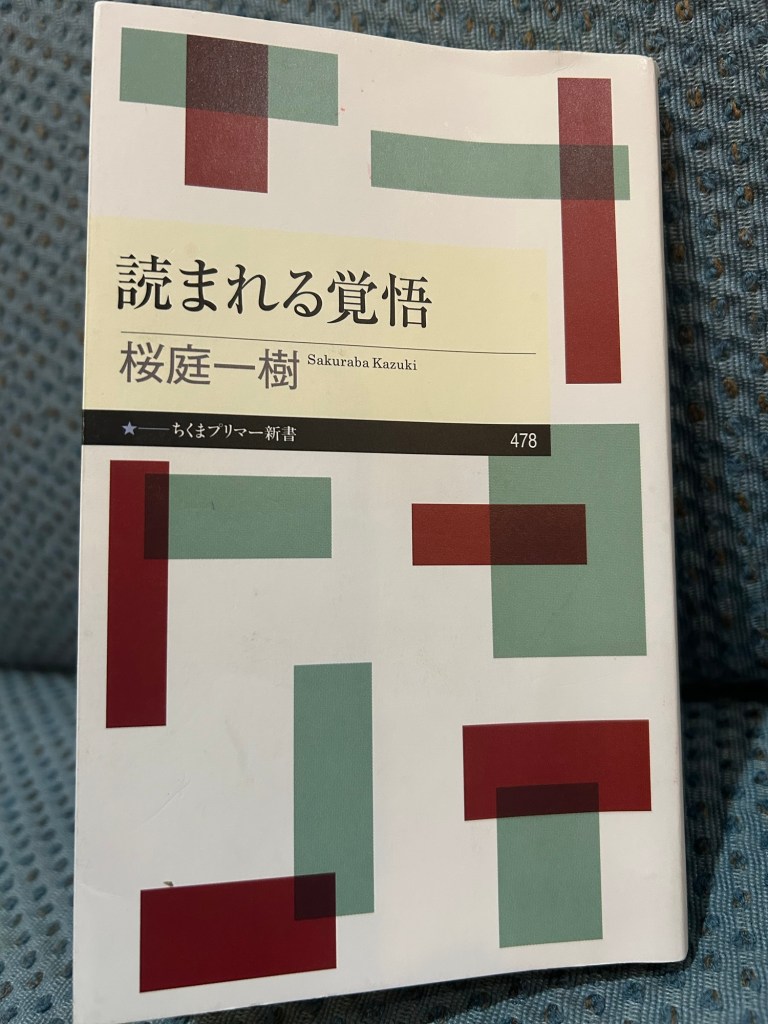
『読まれる覚悟』 桜庭一樹 筑摩書房 東京 2025年 171頁。
I am constantly amazed about the way in which fiction writers seem willing to expose themselves before the whole world. They seemingly have few qualms about the possibility that readers might assume that important scenes in their books are based on the author’s own experiences.
In some cases, I have assumed that the protagonists were the authors’ avatars, who confront challenges similar to what the authors themselves must have gone through. Such books contain scenes and situations that paint the protagonists in what I consider to be an unflattering and negative light. I was impressed by the unflinching ways in which the authors portrayed such scenes, by their authenticity and honesty.
This 2025 book, “Yomareru Kakugo,” which means “Commitment to Being Read,” was written by Kazuki Sakuraba, a veteran fiction writer who made her professional writing debut in 2000. In 2008, her book “Watashi no Otoko” (My Man) won the Naoki Prize for best entertainment novel, a semiannual award that is one of top literary prizes in Japan.
In this book, “Yomareru Kakugo,” the author details her experiences and emotions arising from the various and often surprising ways in which the general reader, as well as professional critics and book reviewers, read her books.
Sakuraba explains how she came to realize that the experience of authoring a book does not end once the author finishes writing the book. Authors might be anxious right after their books are published and only feel at ease if their books sell well.
They must also contend with any reactions to their book from editors, critics, and writers. A key issue is the friction between the writer’s responsibility to allow readers freedom to interpret works of fiction as they like, and the responsibility of readers — especially professional critics and reviewers — to be fair and rational with their interpretations, and to ensure that their interpretations get the facts of the fictional world correct.
These points struck a chord, because I have come to realize how difficult it is to read fictional works thoroughly, while getting the facts right and ensuring that my interpretation doesn’t contradict any facts presented in the book.
Sakuraba has even come across cases where readers or moviegoers would jump into online discussions about books and movies without having read or seen the works themselves. They would react and base their opinions solely on other peoples’ comments about the fictional works.
It is easy to see how frustrating that would be for the creators, and also how such situations can occur over emotionally charged topics.
The author also details the dilemma she feels when she comes across comments by readers that she considers to be factually wrong, or are based on faulty memory (recalling scenes or facts that weren’t in the book at all,) or unfair interpretations that contradict facts or things strongly suggested in the book. How actively should the writer seek to correct the mistakes and misinterpretations of the reader?
The author says she tries to avoid using the “voice of God” as much as possible. When an author offers an explanation about one of their fictional works, they are delivering a verdict on the correct way to read their book. Any other interpretation would then become wrong. Sakuraba says she often holds back from pointing out mistakes made by the general reader, to avoid hurting their feelings, and to give each of them the freedom to interpret fictional works in their own unique way.
One specific reader category that struck a chord with me is the reader that takes snippets from books written by various authors, so that they can include them in a piece of literary criticism. How frustrating that must be for an author, to see their books encapsulated in an almost casual, throw-away manner, so that the critic can make a point. Imagine the frustration a writer might feel if such summaries contain factual errors, or misinterpretations, or pigeonhole the work in a way that the author disagrees with or dislikes.
This book drove home to me the importance of getting the facts right and being fair when interpreting works of fiction. It also made me curious to learn more about the basic concepts and theories underpinning literary criticism, to the point where I’ve purchased and started to read a book mentioned by the author, “Hihyo no Kyoshitsu — Cho no yoni yomi, Hachi no yoni kaku” (“Classroom for Criticism: Read like a butterfly and write like a bee”) by Sae Kitamura. I am hooked and fascinated by this now, and hope that reading such books will help me become better at writing book reviews that are fun to read and stir interest in the books being reviewed.

 Flying Lizard
コメントを残す