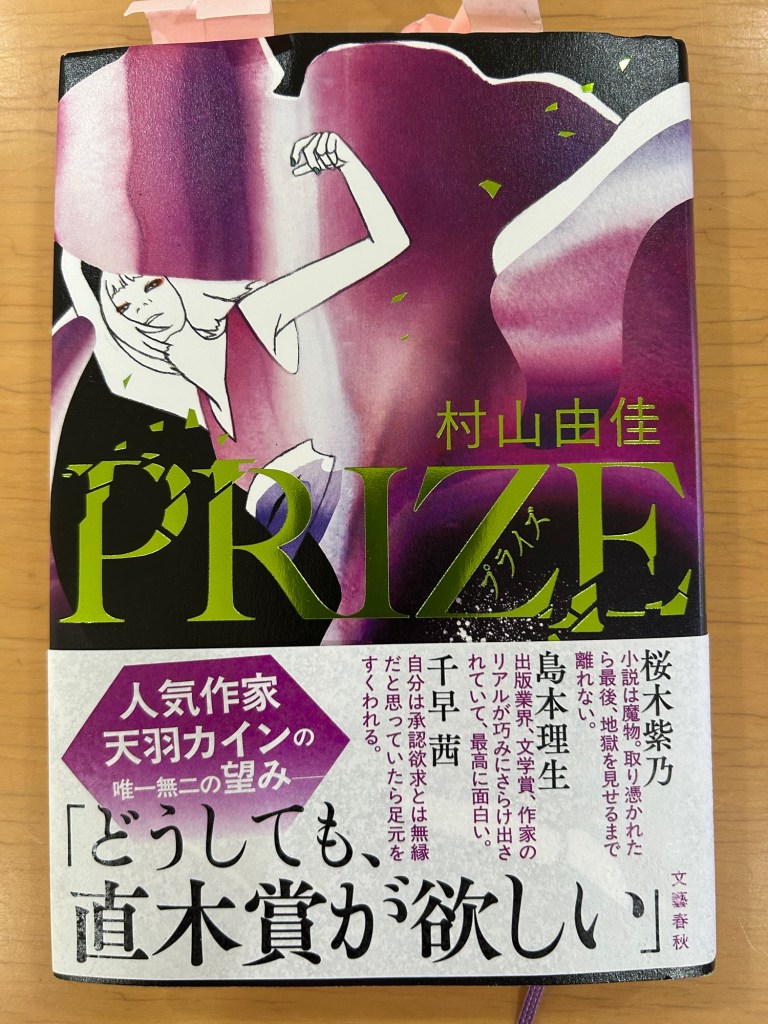
The purple and black cover shows a woman in a purple dress lying down and reaching out for something. A book that seems tailored for a female audience.
Being a middle-aged male, I felt fidgety as I took it to the checkout counter and handed it to a female store clerk, who glanced at me as if to say, “You’re reading this?” Maybe I was just being too self-conscious[1]. In any event, that slightly awkward moment seemed a small price to pay to get my hands on this book, “Prize,” by Yuka Murayama.
When I read the book’s blurb, I was immediately hooked. A story of a writer who desperately wants to win the Naoki Prize, one of the two most prestigious literary prizes in Japan. I figured it would offer a behind-the-scenes look at how Naoki Prize winners are chosen, and insights into the relationship between writers and editors.
I was intrigued by the premise that a veteran author who has already won multiple awards for her “light novels[2],” often fantasy themed stories aimed at teenagers and twenty-somethings, a blue-chip writer that pumps out bestseller after bestseller and prints money for book publishers, would be so eager to win this one particular literary prize. I felt immediate sympathy toward the character and her hunger to win acclaim as a skilled writer of mainstream entertainment fiction.
This isn’t to say that I know what it feels like to be a bestselling author. But I identified with the character’s motivation, striving as I am myself to achieve a “4” evaluation in a book review writing course, which would be tantamount to a stamp of approval from the instructor that the work I submitted is of professional quality.
The novel’s first few pages describe a book-signing event, the type of gathering I’ve been drawn to in the past couple of years. It feels like I’ve been to a lot, but I guess I’ve been to just three[3]. But they were all good, fun opportunities to meet authors up close and to chat with them briefly.
The protagonist is a popular veteran novelist, Kayoko Amano, pen name Kain Amo, who desperately wants to win the Naoki Prize for entertainment fiction, arguably the most influential Japanese literary prize.
With the help of her editors, Amo hopes that this time will be different, that her latest novel “Tsuki no Namae” (Name of the Moon) will be awarded the accolade she has long sought.
The interactions between the mercurial and extremely self-centered Amo and her editors add drama to the proceedings.
After the book signing event, Amo and her editors at fictitious publishing house “Minami Juji Shobo” (Southern Cross Books) make their way to a deluxe Chinese restaurant in Ichigaya in central Tokyo for a celebratory dinner. Feasting on shrimp with sea urchin-flavored cream, shark fin soup and Peking duck, everyone is in a good mood, until Amo calls for a “review” meeting, dumping cold water on the festive atmosphere.
At once, expressions disappear from the faces of everyone present, while Ueno, a general manager at Minami Juji Shobo, lets out a burp, as if on cue.
From there, Amo eviscerates the conduct of all editors who took part in the book signing event, ripping them for having had only four pens for her to sign with instead of five or more, which Amo says was an oversight that caused her to smudge some of her autographs as the pen tips gradually became eroded.
For editors, that might just be one autograph out of 200, but for that particular fan, the autographed book could be something they cherish for the rest of their lives, Amo says. If the staff at Minami Juji Shobo truly believed that the book signing event was a once-in-a-lifetime event for fans of her work wouldn’t they have put all their focus into making sure everything was prepared just right, including every pen and every pen-tip, she asks.
The editors just stare at their tablecloths, unable to raise their faces and meet Amo’s gaze.
The editors, though, had toiled to ensure the success of the book-signing event, whether it be marketing efforts to avoid the embarrassment of a low turnout, or the care with which they dealt with Amo’s legion of fans that day. They had kept pens readily available for Amo to sign autographs with, and carefully stored away fans’ gifts for the author so that they wouldn’t be misplaced.
All that painstaking care and effort, only to be nit-picked over the tiniest perceived mishap. It must be an extremely frustrating position to be in, and it was hard not to feel anger toward the protagonist for her self-righteous behavior.
Amo’s volatile, diva-like personality also comes to the fore in her dealings with her driver. In one scene, she gets into the car, recalls some frustrations and perceived slights she received from someone in the recent past, and suddenly starts kicking the back of the driver’s seat with all her might. The driver endures this without saying a word.
In the book, Murayama describes how difficult it can be for writers to make a living– how challenging it can be to rely on proceeds from writing as the primary source of income. In a year, how many books can a person write, and how many of those can be counted on to sell well enough to make a profit? Winning a literary prize doesn’t guarantee anything, the editors in this story say, almost in unison. To make a living, writers need to continuously publish books that sell many copies.
The editors at Minami Juji Shobo are chagrined when a cocky young author declares that he has quit his day job to work on writing full-time. Why didn’t you talk to us first, they ask the writer, who is nonplused by their angst. Miffed at the less-than enthusiastic reaction of the editors, he asks, why aren’t you congratulating me?
I thoroughly enjoyed reading this book. It was a real page-turner. Whenever I was doing something else, I couldn’t wait to go back to reading it, the first time I felt that way about a book since I read the military thriller “2034: A Novel of the Next World War” by Elliot Ackerman and James Stavridis last year.
Why was I so enthralled by this novel? That stems from my interpretation of the underlying message and theme. I felt as if the book was asking, why do writers write? Do they write for recognition? To become best-selling authors?
It called to mind a conversation I recently had with a friend from college. I mentioned that “Ultimately, we would write even if no one were reading what we write.” “Well, I want people to read what I write,” he replied.
On second thought, I guess l do too. There is perhaps no feeling that is better than the satisfaction you get, when you sense that something you’ve written, your ideas and thoughts, have been clearly communicated, and positively affected the reader in some way. Maybe they found enjoyment, received intellectual stimulus, or their curiosity was aroused, prompting them to do some more reading on the topic, go watch a documentary or a movie, or go talk to a friend.
If you sense that this mission has been accomplished, that the essence of what you have written has reached even one other person, it provides a great deal of satisfaction, and if that message were to reach a much wider range of people, I’m sure that sense of fulfillment will be even greater.
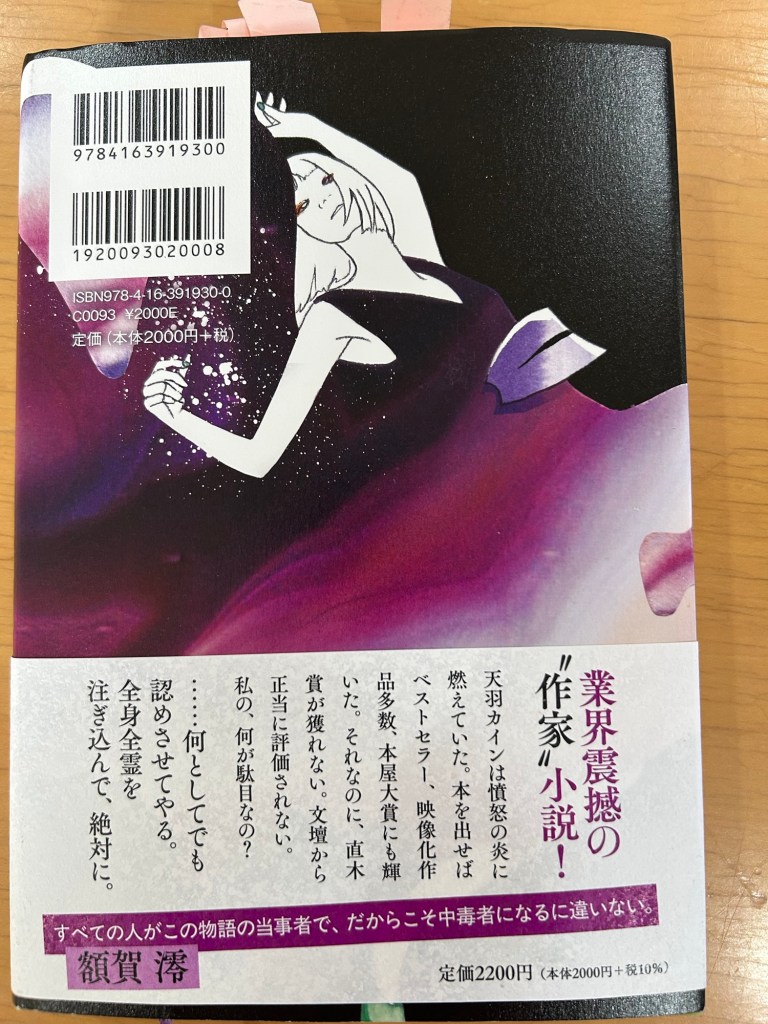
My interest in the plot sagged a bit toward the end, when the deep and extremely co-dependent relationship between Amo and one of her editors, Chihiro Ozawa, became the main focus. [4]
I also felt that parts of the book, including monologues and conversations among some of the characters, meandered into topics and opinions that detracted from what I considered to be the book’s main themes — why do people write, and the relationship between writer and editor. But in one scene, Murayama, as if she had anticipated such interpretations, has a book publisher read out loud comments from panelists for a literary prize, in which they criticize writers for making their characters espouse views that are actually the author’s own opinions. I don’t know if Murayama was expressing her own views through her characters, but that injection of meta criticism gave me the impression that the author was well aware of what she was doing and wanted to nip such negative interpretations in the bud.
Once I read the book to the end, there was a sense of closure, and I felt like I wanted to congratulate Amo, telling her that she got what she wanted.
This book was published in January 2025, and it’s just too bad that Murayama already won the Naoki Prize[5] in 2003 with her book “Hoshiboshi no Fune.” It would have been fun to see what the Naoki Prize panelists would have said about this book, and I think “Prize” would have been all the more impressive if it were written by someone who has yet to win the Naoki. But then again, I guess it’s probably the type of story that could have only been written by someone who has already won the prize.
[1] When I submitted a Japanese version of this article to a book review writing course, the general tone of the feedback from female participants was that I was being too self-conscious. They didn’t have any qualms with the book cover.
[2] The definition of “light novel” a book genre in Japan is based on a description on book publisher Gentosha’s “Gentosha Rennaisance” website.
[3] The first one was a book signing event by Rie Kudan for her Akutagawa Prize-winning book “Tokyotodojoto,”at Kinokuniya in Shinjuku in February 2024, the second was an event by animal linguistics pioneer Toshitaka Suzuki for his book “Boku ni wa Tori no Kotoba ga Wakaru,” at Junkudo in Ikebukuro, the third was by Katy McQuaid for “Humble Yet Fierce,” a book about her experiences in the U.S. Central Intelligence Agency, at the International Spy Museum in Washington, D.C.
[4] I was at a loss at how to describe their relationship, until the instructor of the aforementioned book review writing course mentioned “co-dependent” as a possibility. I think that’s a good encapsulation and I borrowed that here.
[5] It’s a prize that a writer can only win once.
 Flying Lizard
コメントを残す