『カフネ』 阿部暁子 講談社 2024年 302頁。
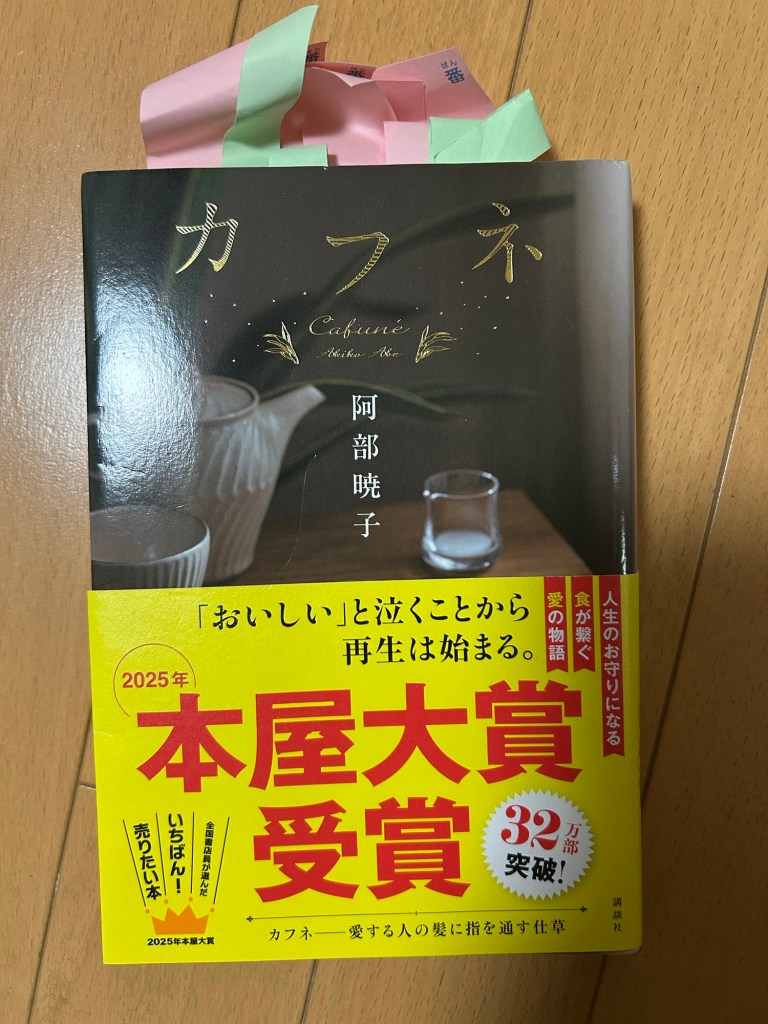
As this novel, Cafune, begins, Kaoruko Nomiya, 41 and recently divorced, is sitting at a table in a café in Hachijoji, a residential suburb in western Tokyo, getting angrier by the minute.
Kaoruko’s younger brother, Haruhiko, had unexpectedly passed away at the age of 29 just the month before, and on a sunny Saturday afternoon in April, Kaoruko is due to meet the woman whom he had been seeing, to discuss the terms of his will.
Kaoruko texts the woman, Setsuna Onodera, admonishing her for her lack of courtesy. She should at least let Kaoruko know that she is on her way, Kaoruko thinks. Setsuna, though, doesn’t respond. Moreover, there is no sign that she has even bothered to read the message, which stokes Kaoruko’s anger even further.
Written by Akiko Abe, who made her debut as an author in 2008, Cafune was the No.2 best-selling “general category” book in Japan in 2025, a bracket that excludes comics and paperbacks, according to book distributor Nippon Shuppan Hanbai Inc.[1] Abe won the 2025 HonyaTaisho (Booksellers’ Award) for this novel, which takes its title from a Brazilian Portuguese word that signifies tenderness.
When Setsuna finally arrives, she does little to soothe Kaoruko’s anger. Haruhiko had left an inheritance for Setsuna, and Kaoruko wants her to accept it, but Setsuna declines.
This infuriates Kaoruko, and she suffers a fainting spell as she leaves the café.
Kaoruko, a civil servant who works for the local legal affairs bureau, is exhausted in the wake of her brother’s death and her breakup with Kimihiko Takita, a children’s rights lawyer, after a marriage of nearly five years and repeated fertility treatments.
Against her protestations, Setsuna accompanies the weakened Kaoruko to her apartment, which is a complete mess. Cardboard boxes from online shopping, as well as garbage bags full of empty “haichu” cocktail cans and other litter, line the hallway. The kitchen sink is filled with dirty, unwashed dishes.
Kaoruko ends up falling asleep on the couch while Setsuna prepares cold noodles.
Once she wakes up, Kaoruko tries the food that Setsuna prepared. She is surprised by how good it tastes and can’t help but admire how good it all looks and she starts to cry.
Before long, Kaoruko decides to join Setsuna at “Cafune,” a company that provides housekeeping services, as a volunteer on weekends. The firm hands out free Saturday service tickets that customers can give to anyone that needs housekeeping help.
During these Saturday sessions, Kaoruko and Setsuna come across people in various circumstances including a middle-aged man who looks after his ageing mother, a woman and her daughter, a fifth grader, who has become angry and cynical after her father passed away, a teenage boy and his little sister whose mother is often out of the house, trying to make ends meet.
The two work well together and Kaoruko finds herself engrossed in the work and increasingly at peace, getting a sense of fulfillment from helping others.
Over the course of the story, Kaoruko reflects on her time with Kimihiko and the causes that may have led him to ask for a divorce.
She also gains a clearer picture of the circumstances surrounding the death of her younger brother, comes to terms with her relationship with her parents, and learns more about Setsuna’s background and upbringing.
Besides putting a spotlight on how arduous household tasks can be for caregivers, the novel also shows how difficult it can sometimes be for people to tell those close to them what they really want, while being sensitive to the wants of others.
[1] The “Sogo” (general category) ranking excludes collected works, “bunko” paperbacks, game walkthroughs and comics, according to Nippon Shuppan Hanbai Inc.
 Flying Lizard
コメントを残す