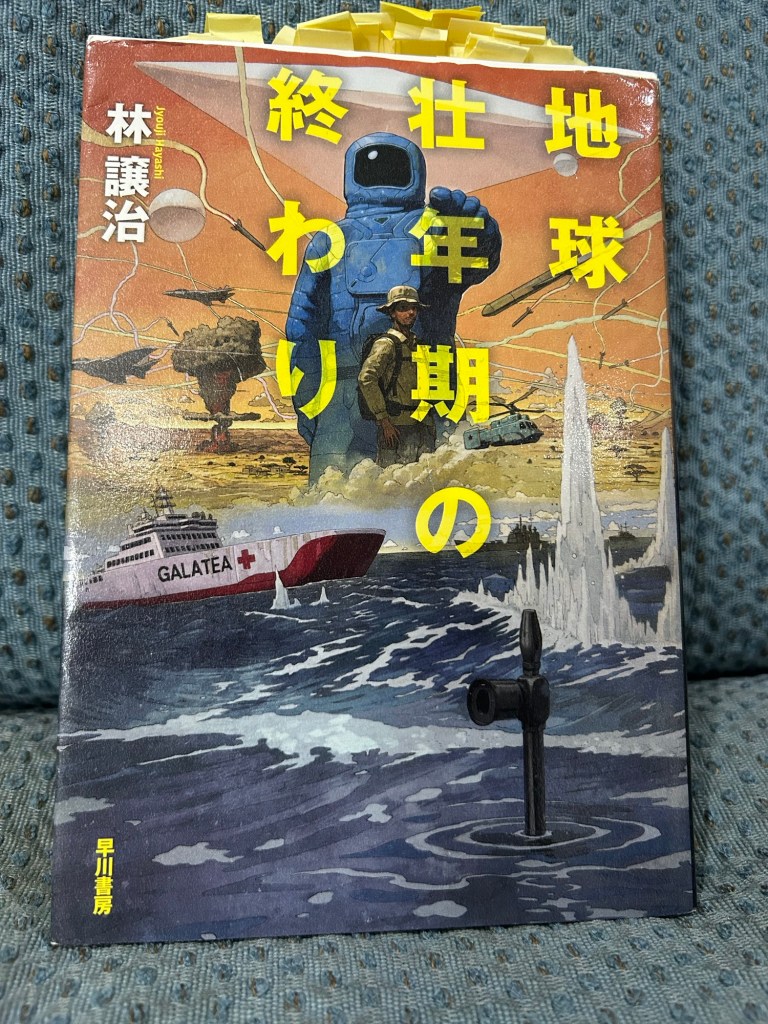
This book, Chikyu Sonenki no Owari (The End of Earth’s Prime Years[1]), is a science fiction novel about mankind’s first contact with extraterrestrials. With the title, the author seems to be paying homage to Arthur C. Clarke’s 1953 science fiction classic Childhood’s End[2] that dealt with a similar theme.
In addition, it’s a piece of speculative fiction about international politics. The story is set in 2034, which calls to mind a military thriller[3] published a few years ago about a fictional war between the United States and China.
The author, Jyouji Hayashi, is well-versed in both genres. A former clinical laboratory technician, Hayashi made his writing debut in 1995[4] with Dai Nippon Teikoku Oshu Dengeki Sakusen (The Empire of Japan’s European Blitz Operation), a series of novels set in World War Two that he co-wrote with Nobuhito Takanuki, a fellow writer and military analyst. In 2021, Hayashi won the Japan SF award for his nine-volume series Seikei Izumo no Heitan (The Military Logistics of Star System Izumo).
I spotted Chikyu Sonenki no Owari (The End of Earth’s Prime Years) at a local book store a few months ago and was intrigued by the cover, which shows someone in a blue space suit pointing toward the reader. A smaller person in military fatigues stands in front. Several missiles are hurtling through the air while a blast is visible in the distance. A huge pyramid-shaped object floats in the sky along with a couple of white spheres. A medical ship, military vessels and a periscope are depicted in the foreground. Columns of water are shooting up from the ocean surface.
The story starts in Egypt on Oct. 15, 2034. Yusuke Beniya, one of the protagonists, is driving a truck in the desert. He has been hired by Japan’s Self-Defense Forces to transport cargo. His task is a dangerous one, taking place in a region where countries are at war over precious water resources.
Beniya is forced to flee when a column of trucks that he is travelling with comes under attack. As he traverses the desert, Beniya eventually comes into contact with an alien named “Kaskelis” who is 3 meters tall and is wearing something that looks like a blue space suit.
As was the case in Childhood’s End, humans and aliens understand each other right off the bat. Communication in this case is facilitated by an automatic translator embedded into the protective suits donned by the aliens. The visor on their helmets handles the translation. When Beniya first meets Kaskelis, the alien’s helmet takes a few minutes to adjust its settings before starting simultaneous translation of Beniya’s Japanese to the aliens’ language and vice versa.
The aliens have come to Earth from a star system 7,000 light years away. They are here for reconnaissance ahead of a planned invasion.
Kaskelis expresses puzzlement over the wars taking place on Earth, asking Beniya why mankind engages in so much killing. Are humans cannibals that kill each other for food, Kaskelis asks Beniya. The aliens had been cannibals themselves long ago, earlier in their history.
While Beniya is disgusted by the mention of cannibalism, he gradually begins to understand why the aliens – whom he starts referring to as “Scavengers” — might be baffled by all the fighting that takes place on Earth.
As they travel together across the desert, Kaskelis takes Beniya to a group of people who are working on a project aimed at preserving human knowledge. Their mission is to recover and build a repository of knowledge, culture and scientific data that have been lost during wartime and as government attacks against institutions of higher education and research intensified globally.
At the group’s base, Beniya meets Reika Aonuma. a fellow naturalized Japanese citizen and former refugee.
Aonuma, an ex-banker and freelance journalist, is on the run after stealing some 2.7 billion yen ($17 million) in laundered funds. Aonuma pilfered the money from a team of Japanese intelligence operatives that she had been working for, having transferred the funds to her own overseas bank account.
The funds, Aonuma thinks, come from a clandestine casino project plagued by losses that her employers are trying to hide. Their real purpose, however, is revealed to be much more nefarious. A Scavenger helps Aonuma elude her would-be captors and takes her to the knowledge haven, where she meets Beniya.
There is another storyline involving a medical ship that aids refugees. At one point, it delves into negotiations that take place among different factions on the medical ship. I didn’t find that part to be as compelling as the other two storylines.
Among the draws of this novel are the interactions between Beniya, Aonuma and the Scavengers. Their exchanges are fun to follow, helped by the Scavengers’ unintentionally droll sense of humor. In addition, the purpose of the Scavengers’ visit to Earth remains an intriguing mystery for much of the book. The Scavengers claim to be planning an invasion and yet, they seem willing to help Beniya, Aonuma and the knowledge haven project. What are they really aiming for?
While taking the form of science fiction, this novel, like the aforementioned military thriller 2034, reads more like a piece of contemporary fiction, taking up topics such as competition for natural resources, discrimination that refugees may face outside their homeland, as well as Japan’s national security policy. The speculative scenario the author lays out in the book, about Japan’s military strategy and the U.S.-Japan security alliance, is grim and excruciating. I hope such a scenario never comes to pass.
Reading this book can lead to angst about where Japan and the world might be headed in the coming years. The book, however, also contains encouraging messages that leave one hopeful for the future.
[1] The English translation is my own attempt and not an official translation.
[2] Arthur C. Clarke, Childhood’s End (London: Gollancz, 1953, eBook edition 2011).
[3] Eliot Ackerman and James Stavridis, 2034: A Novel of the Next World War (Penguin Publishing Group, 2022).
[4] The author’s background is based on his bio on the Science Fiction and Fantasy Writers of Japan’s website. https://sfwj.jp/member-list/jyouji-hayashi/


コメントをどうぞ