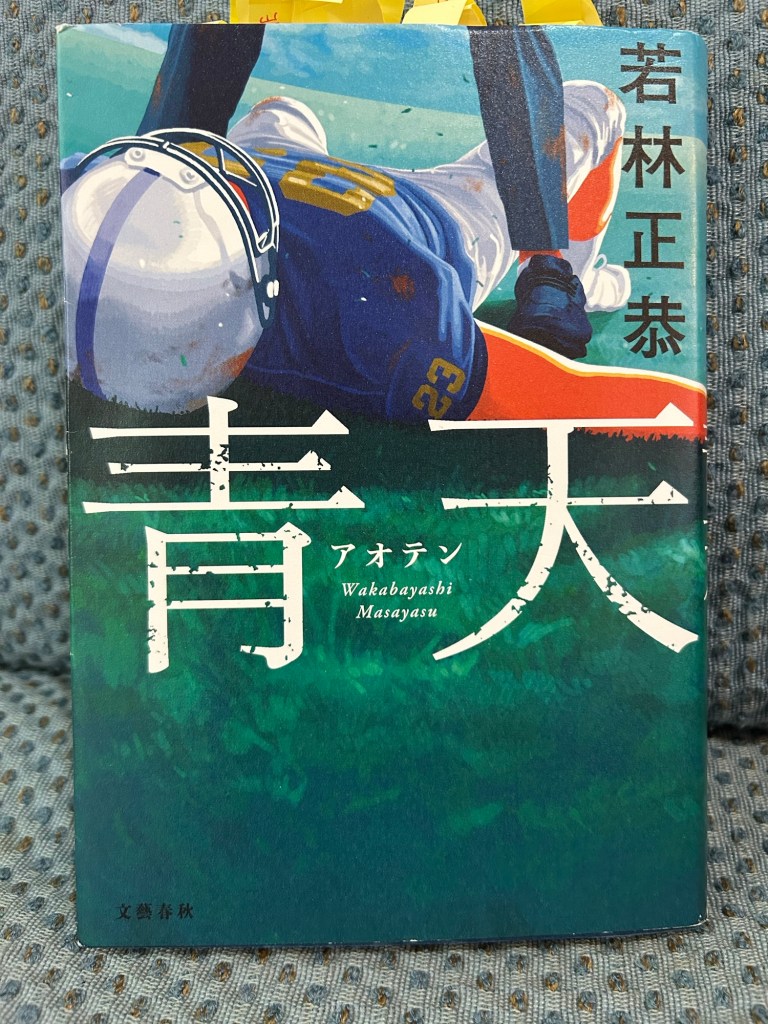
This book, a novel about Japanese high school students and American football, has become something of a phenomenon in Japan, having gone to its fifth printing within a month after it was first published in February.
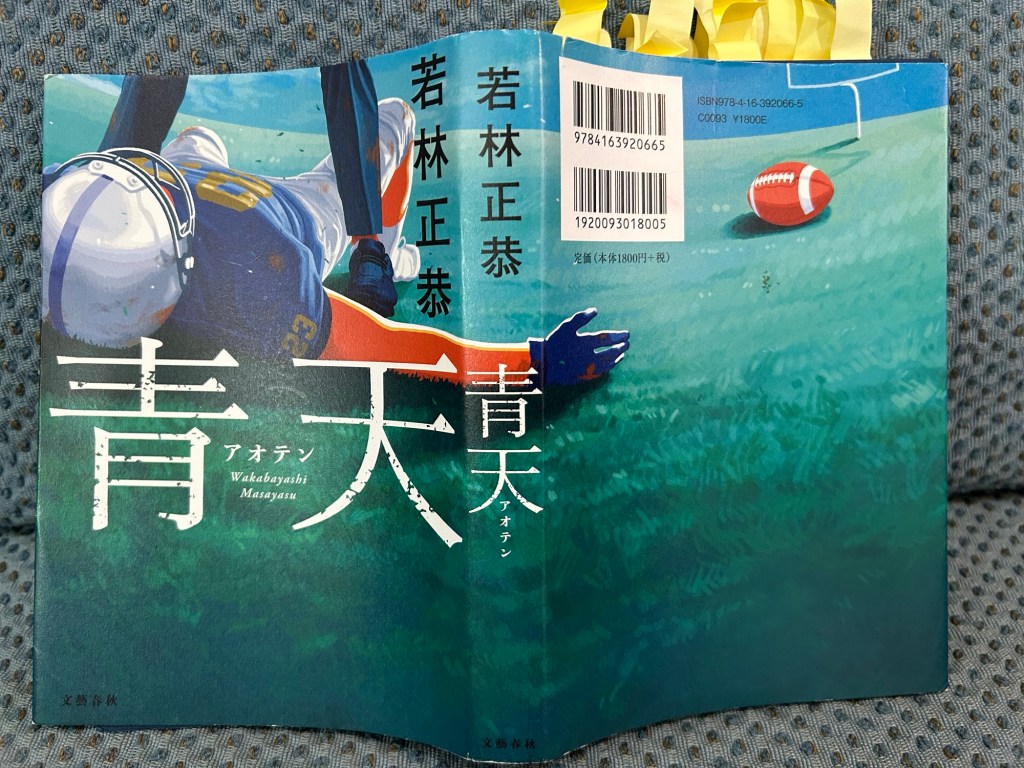
The title, Aoten, roughly translates to “blue sky”. It’s a term that describes what players see when they take a hard hit and get knocked flat on their back. Getting “aotened” is the most humiliating moment that a football player can encounter, according to the book’s protagonist.[1]
The author, Masayasu Wakabayashi, was born in Tokyo in 1978 and made his publishing debut in 2013 with a collection of essays. Aoten is his first novel.
Wakabayashi is best known as a member of a veteran comedy duo called “Audrey”[2] that became a household name in Japan about 15 years ago. The duo, consisting of Wakabayashi and Toshiaki Kasuga, had gone to the same high school in Tokyo and were teammates on the school’s American football team. They are both known as being fervent fans of the sport.
The novel is set in 1999. As the story begins, two high school students — the protagonist, Subaru Nakamura, who goes by the nickname “Ari,” and his friend Tsukasa Kawase — are hiding in a forest in western Tokyo, dressed in camouflage and carrying a digital camera.
They are looking for a good vantage point to record the practice of a rival football powerhouse, a team that they are slated to play against in a couple of weeks. Their attempt at reconnaissance proves short-lived, however. Players from Ryosei Gakuen, the rival team, quickly spot the spying duo and chase them down. Ari and Kawase make a run for it but to no avail. Ari is tackledby Ibe, a hard-hitting safety who is Ryosei Gakuen’s team captain, and gets knocked flat on his back.
Ari and Kawase are then taken before the Ryosei Gakuen team’s head coach, who magnanimously lets them watch the whole practice. The coach is used to seeing this type of spying activity, and he knows that the school these two belong to, Sodai Sanko, is a lesser, undermanned program that has little chance of putting together a competitive performance, much less defeat his talented and well-trained team.
Having seen the might of Ryosei Gakuen up close, Ari and Kawase decide to craft a game plan full of misdirection and trick plays, hoping to pull off a highly improbable upset.
Naturally, little goes according to plan. The gap in talent, physical ability and coaching is just too large to overcome. On the day of the game, as the Ryosei Gakuen defensive unit steps onto the gridiron in their black uniforms, Ari is reminded of the opening scene of Reservoir Dogs.[3] In the final game for outgoing seniors before they shift their focus to studying for college entrance exams, Sodai Sanko is annihilated by Ryosei Gakuen. The final score is a merciless 0-84.
After the game, Ari and Kawase lie on their backs on the rooftop garden of Tokyu Department Store in Kichijoji in western Tokyo, discussing their plans for the future. Kawase – a brainy football nerd – reckons he is too thin to play football at the collegiate level. His goal is to get into college, become an equipment manager for the football team and to work his way up, in hopes of eventually becoming a game-planning coordinator.
Ari, for his part, thinks his grades are too poor for him to have any hope of going to college. Ari runs 50 meters in 6.9 seconds – too slow, he thinks, to play running back in college. Disgusted by Ari’s attitude, Kawase says Ari should study to improve his grades and train to run faster. There are some who can’t play in college even if they wanted to, Kawase tells Ari.[4]
Without American football in his life, Ari loses his way. All his former teammates, including Kawase, are busy studying for their college entrance exams and Ari soon discovers that he has no one to talk to after school. He starts skipping school to play mahjong, and finds himself getting invited to an alcohol-infested party at a nightclub in Shibuya, the entertainment district.
Luckily for Ari, he is saved by an underclassman from the football team named Takayama. Takayama, the starting quarterback, invites Ari to re-join the team to play in an upcoming, Tokyo-area autumn tournament.
Ari starts training by himself in the early mornings and reaches out to his buddy, Kawase, asking for advice on how he should practice and train. He is eventually joined at these early morning sessions by Takayama, and the two start practicing option plays at Kawase’s behest.
In school, Ari develops a curiosity for philosophy and starts peppering his ethics class teacher with questions. Pleasantly surprised, the instructor, Iwasaki, is happy to oblige. She urges Ari to start studying for college entrance exams, even if the odds seem stacked against him. There is darkness in every light, but there is also always some light in every darkness, Iwasaki says, suggesting that Ari still has a chance to gain admission to college.
At the autumn tournament, Ari and Takayama’s Sodai Sanko team win a hard-fought game and advance to the second round for a re-match against their arch-nemesis, Ryosei Gakuen, and Ibe — the speedy safety who had decleated Ari after that ill-fated spying mission.
Ahead of the re-match, Ari approaches Iwasaki — the ethics teacher — for advice. Ari doesn’t think his team can win against Ryosei Gakuen, and is troubled by that notion.
In reply, Iwasaki talks about Albert Camus’s work, The Myth of Sisyphus. According to Greek myth, Sisyphus, the king of the ancient city of Corinth, would roll a boulder all the way up a hill. Then, just as the rock seemed poised to rise beyond the crest and roll toward the other side of the hill, it would get knocked back, and roll all the way back down the way it came.[5] Even so, Sisyphus presses on, and keeps pushing the boulder back up the hill.
Attempting to change one’s fate may prove futile, but you always have the option of trying to resist it regardless, Iwasaki tells Ari, adding that everyone has the freedom to make that choice. Camus’s view is that anyone who pursues such an endeavor must be thought of as being happy, she adds.[6]
Before long, game day arrives. While Ari and his teammates are better than they were in spring, Ibe and Ryosei Gakuen have also improved. By late in the third quarter, Ryosei Gakuen, as Ari had feared, has rolled to a seemingly insurmountable 52-0 lead, forcing Ari to confront his own Sisyphus moment…
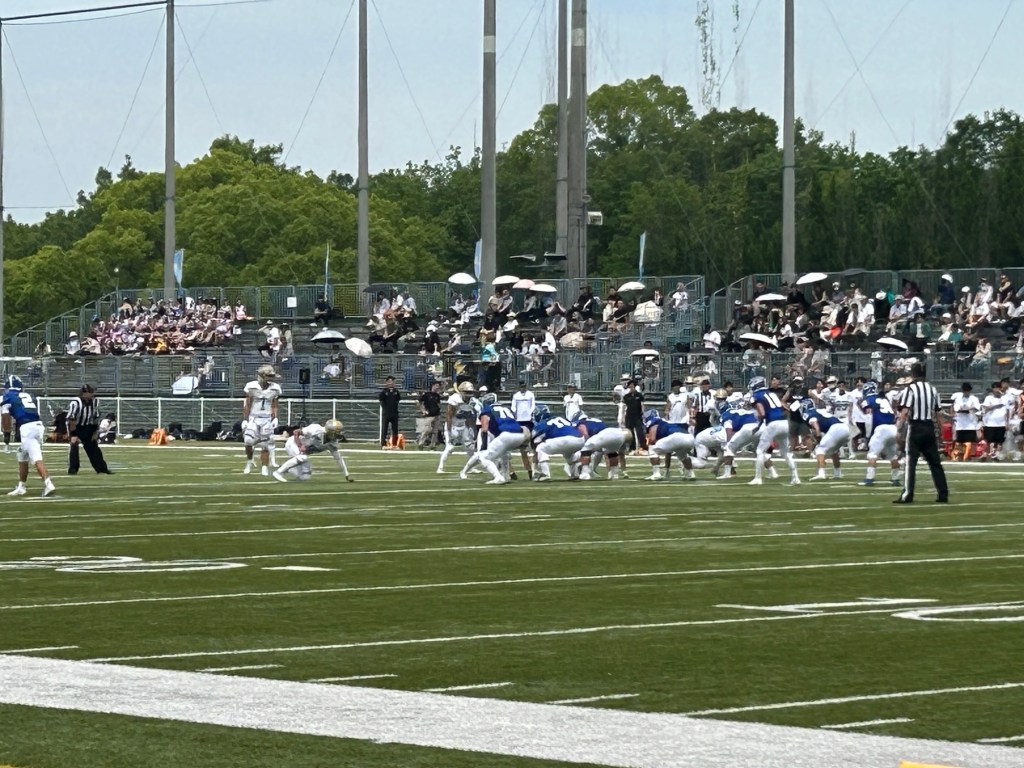
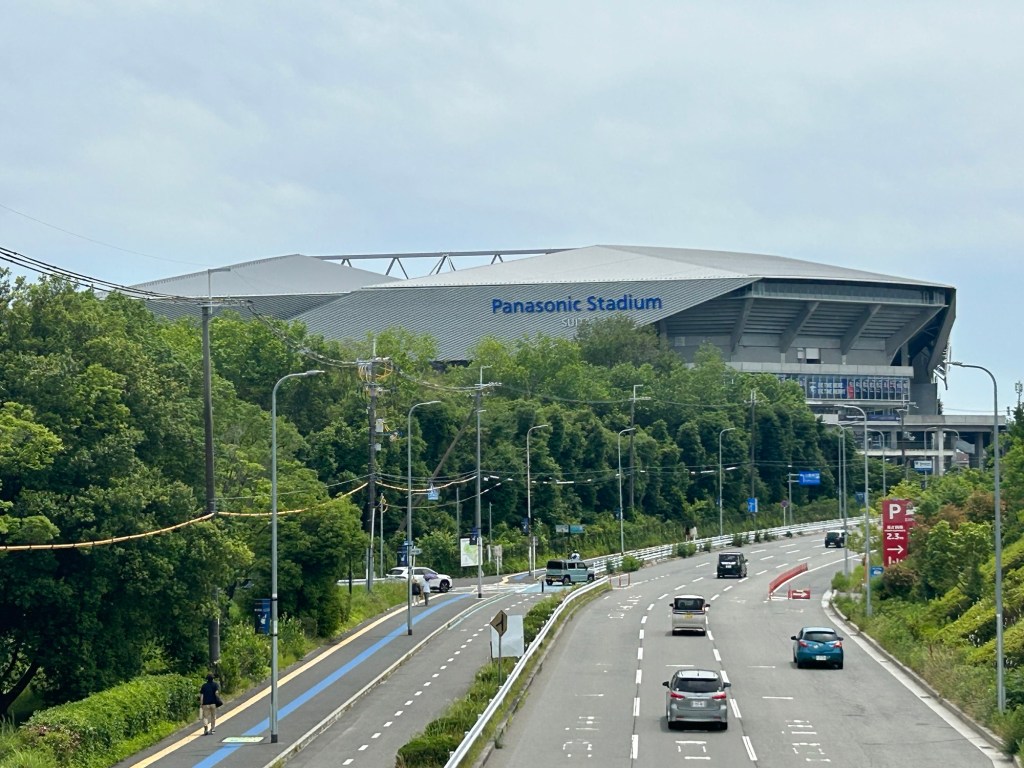
This novel is one of the most engrossing books that I’ve read so far in 2026. Reading it made me want to go watch a football game in person, and in late May, I went to see a college football game in Osaka, one that was played on a hot, sweltering day under a cloudy but light-blue sky.
[1] Wakabayashi, Aoten, 66-67.
[2] The duo’s name is said to have been inspired by Audrey Hepburn, adopted in the hope that the name would bless the pair with similar star power. As the story goes, the head of their talent agency gave the duo an ultimatum, a choice between “Audrey” and “Uniikura” (Seaurchinsalmonroe).
“Audrey, konbimei wa gyokairui ni naru sunzendatta! Group mei de namidashita idoru ni yurai akasu,” Daily Sports, Nov. 9, 2023, https://www.daily.co.jp/gossip/2023/11/09/0017011067.shtml.
[3] Wakabayashi, 65.
[4] Wakabayashi, 83.
[5] Homer, The Odyssey, trans. E.V. Rieu (London: Penguin Books, 2003), 155.
[6] Wakabayashi, 289-291.


コメントを残す